Anderson SC Basement & Crawl Space Encapsulation: Preventing Moisture
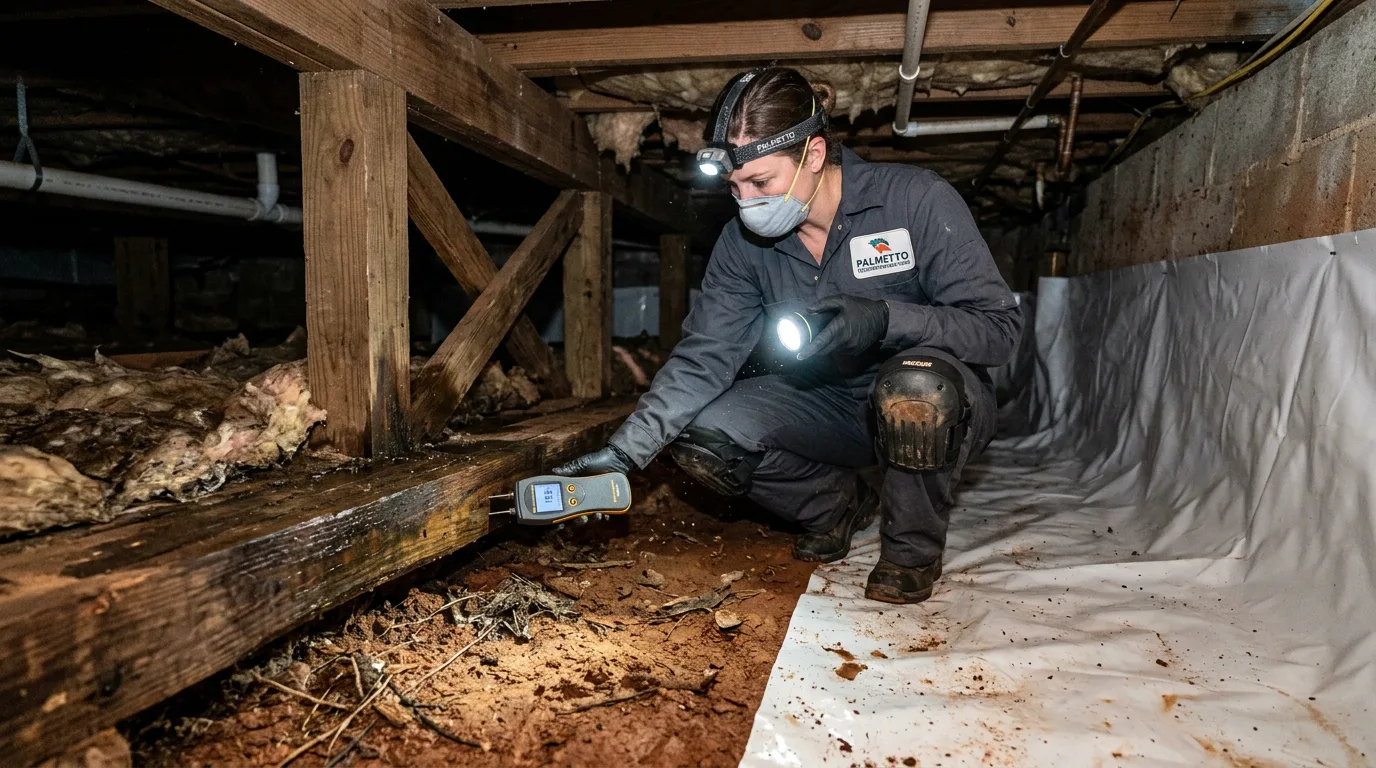
Anderson County homeowners who have dealt with crawl space moisture, musty smells, or high indoor humidity for years are often told to “get the crawl space encapsulated” without a clear explanation of what that actually means, what it costs, or whether it will actually solve the problem. This guide provides that explanation — specifically for the clay soil and high-rainfall conditions that make crawl space moisture a particularly persistent problem in Anderson, SC.
In this post, we cover what crawl space and basement encapsulation involves, the specific soil and climate factors that make it necessary in Anderson County, what the installation process looks like, and what realistic expectations should be for long-term moisture control in Upstate South Carolina.
Crawl Space Moisture in Anderson? Free Inspection Available
We assess your specific moisture situation before recommending any solution. Call Anderson Water Damage Pros at (877) 698-1311.
What Crawl Space Encapsulation Actually Is
Crawl space encapsulation is not a single product or a single installation step — it’s a system that addresses the multiple sources of moisture that enter Anderson crawl spaces. A complete encapsulation system includes:
Heavy-duty vapor barrier: A minimum 12-mil (ideally 20-mil) reinforced polyethylene barrier that covers the entire crawl space floor and extends up foundation walls to the sill plate, sealed at all seams and penetrations. This barrier prevents ground moisture from the clay soil below from evaporating into the crawl space air.
Foundation vent sealing: Traditional vented crawl spaces rely on outdoor air to control moisture — a design that works reasonably well in dry climates but actively worsens conditions in Anderson’s humid subtropical environment. Outdoor air in Anderson from June through September is often at 70%+ relative humidity. When this air enters a slightly cooler crawl space, it cools further and deposits moisture on structural surfaces. Sealing foundation vents is the counterintuitive but evidence-supported solution for humid climates.
Dedicated crawl space dehumidifier: After vents are sealed, the crawl space becomes a semi-conditioned space that requires active humidity control. A dedicated crawl space dehumidifier — sized appropriately for the square footage and moisture load — maintains relative humidity below 55–60% year-round, below the threshold where mold can establish. These units drain automatically and include humidity sensors that cycle the unit as needed.
Drainage system (when needed): For crawl spaces that also receive water intrusion from foundation wall cracks or high groundwater pressure — more common in Anderson’s lower-lying areas near Lake Hartwell — a perimeter drainage system or sump pump installation may be added to the encapsulation system.
Why Anderson County’s Conditions Make Encapsulation Especially Important
Anderson County receives 48 inches of rainfall annually, and the region’s expansive clay soils absorb and hold this moisture far longer than sandy or loam soils would. The clay-soil shrink-swell cycle creates foundation movement that opens gaps at the sill plate and foundation penetrations — pathways for both humid air and occasional water entry. Homes throughout the Pendleton Historic District and older parts of West Anderson face this dynamic continuously.
The condition of existing vapor barriers in older Anderson homes compounds the problem. Homes built before 1980 often have either no vapor barrier at all or a thin (4–6 mil) polyethylene sheet that has been torn by pest activity, shifted by crawl space traffic, or simply degraded over decades. These partial barriers provide minimal moisture control and can create concentrated high-humidity zones where water vapor accumulates before rising through gaps in the subfloor.
In Anderson’s summer months — when outdoor humidity peaks and temperatures create ideal mold conditions — an unencapsulated crawl space effectively becomes a mold incubator. Floor joist moisture content readings above 20% are common in summer inspections of unencapsulated Anderson crawl spaces. Readings this high indicate active moisture conditions that will produce visible mold within months if not addressed.
Encapsulation Quotes for Anderson County Homeowners
We provide itemized written quotes for crawl space drying and encapsulation — no surprises. Call (877) 698-1311 to schedule an inspection.
Options and Materials for Anderson Crawl Space Encapsulation
12-mil polyethylene vapor barrier: The minimum standard for residential encapsulation. Adequate for most Anderson homes with moderate moisture loads and no standing water history. White reinforced polyethylene is standard.
20-mil reinforced vapor barrier: Recommended for Anderson homes with history of standing water, high pest activity in the crawl space, or very limited access where servicing the barrier is difficult. More puncture-resistant and longer-lasting.
Dedicated crawl space dehumidifiers: Look for units specifically designed for crawl space environments — they’re built to operate in tight spaces with high humidity, drain automatically, and run more efficiently at high humidity levels than portable household dehumidifiers. Sizing matters: a 1,000 square foot crawl space in Anderson requires approximately a 70-pint-per-day unit minimum.
Spray foam for penetration sealing: All plumbing, electrical, and HVAC penetrations through the foundation and sill plate should be sealed with spray foam as part of the encapsulation installation, eliminating the humidity bypass pathways that undermine vapor barrier effectiveness.
The Encapsulation Installation Process
A professional crawl space encapsulation installation for a typical Anderson County home proceeds as follows:
- Inspection and moisture assessment: Moisture readings throughout the crawl space establish baseline conditions and identify specific problem areas.
- Existing material removal: Old torn vapor barriers, deteriorated insulation, and any damaged materials are removed.
- Mold treatment (if present): Any visible mold on framing is HEPA-vacuumed, wire-brushed, and treated with EPA-registered antimicrobials before the barrier is installed. Never encapsulate over active mold.
- Vapor barrier installation: The barrier is cut to fit the crawl space floor and walls, secured with tape and adhesive at all seams and penetrations.
- Foundation vent sealing: Existing vents are sealed with rigid foam board or vent covers designed for this purpose.
- Dehumidifier installation and drainage: The dehumidifier is positioned for optimal air circulation, connected to a drain line, and set to the target humidity level.
- Final inspection: Moisture readings are taken throughout to confirm the encapsulation system is performing correctly.
Cost of Crawl Space Encapsulation in Anderson
Full crawl space encapsulation in Anderson typically costs $3,000–$8,000 for residential properties in Anderson County, depending on the square footage of the crawl space, the moisture load, and whether drainage modifications are required. This is a one-time investment rather than an ongoing expense — a properly installed system provides 15–25 years of effective moisture control.
The comparison that puts this cost in context: floor joist replacement in a single crawl space bay — the typical outcome of years of uncorrected crawl space moisture — runs $3,000–$8,000 for the repair alone, without the encapsulation that prevents it happening again. The math strongly favors encapsulation as a proactive investment over reactive structural repair after moisture has caused damage.
Frequently Asked Questions
Does crawl space encapsulation eliminate mold in my Anderson home?
Encapsulation prevents the moisture conditions that support mold growth — it does not remediate existing mold. If mold is present on framing when encapsulation is installed, it must be professionally remediated first. Encapsulation over active mold will trap it in a warm, contained environment where it can continue growing. Our process always includes mold assessment and remediation as step one when active growth is found, followed by encapsulation to prevent recurrence. Learn more in our crawl space water damage guide for Anderson.
How long does crawl space encapsulation installation take in Anderson?
A standard residential crawl space encapsulation in Anderson takes 1–2 days for installation. Larger crawl spaces (over 2,000 sq ft), those with very limited access, or those requiring drainage modifications may take 2–3 days. Prior drying if active standing water is present adds 3–7 days before installation begins. We provide a realistic timeline estimate based on an on-site inspection before any work begins.
Will encapsulation help with my Anderson home’s high indoor humidity?
In most cases, yes significantly. For Anderson homes where the crawl space is the primary moisture source — which is the case for most older unencapsulated crawl space homes in Anderson County — encapsulation reduces indoor humidity noticeably, often eliminating the need to run the HVAC in dehumidification mode continuously during summer. Some homeowners report that indoor humidity drops 10–15% after encapsulation, which also reduces air conditioning load and energy costs. The improvement is most noticeable in lower-floor rooms directly above the crawl space.
Related:
- Crawl space drying and encapsulation service
- Crawl space water damage in Anderson, SC
- Mold remediation in Anderson, SC
Permanent Crawl Space Moisture Control in Anderson County
We install complete encapsulation systems — vapor barrier, vent sealing, and dehumidification. Call Anderson Water Damage Pros at (877) 698-1311 for a free inspection.